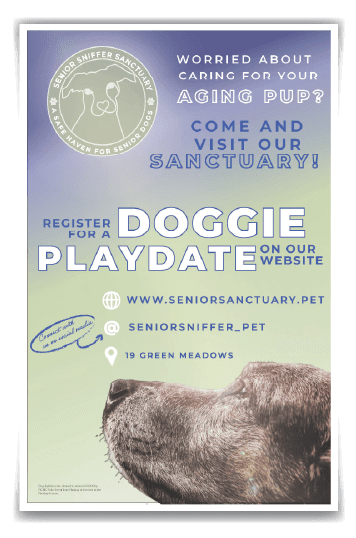
Doggie Playdate Poster
Layout and Publication
Project Overview: Doggie Playdate Poster
This project was completed as part of my BA in Graphic Design and Media Arts, with a concentration in Web Design curriculum. It demonstrates my ability to meet specific project briefs, adhere to deadlines, and apply design theory to simulated or real-world client scenarios.
Role: Graphic Designer
Tools: Adobe Illustrator
Focus: Grid Systems, Minimalist Typography, and Color Theory
The Challenge
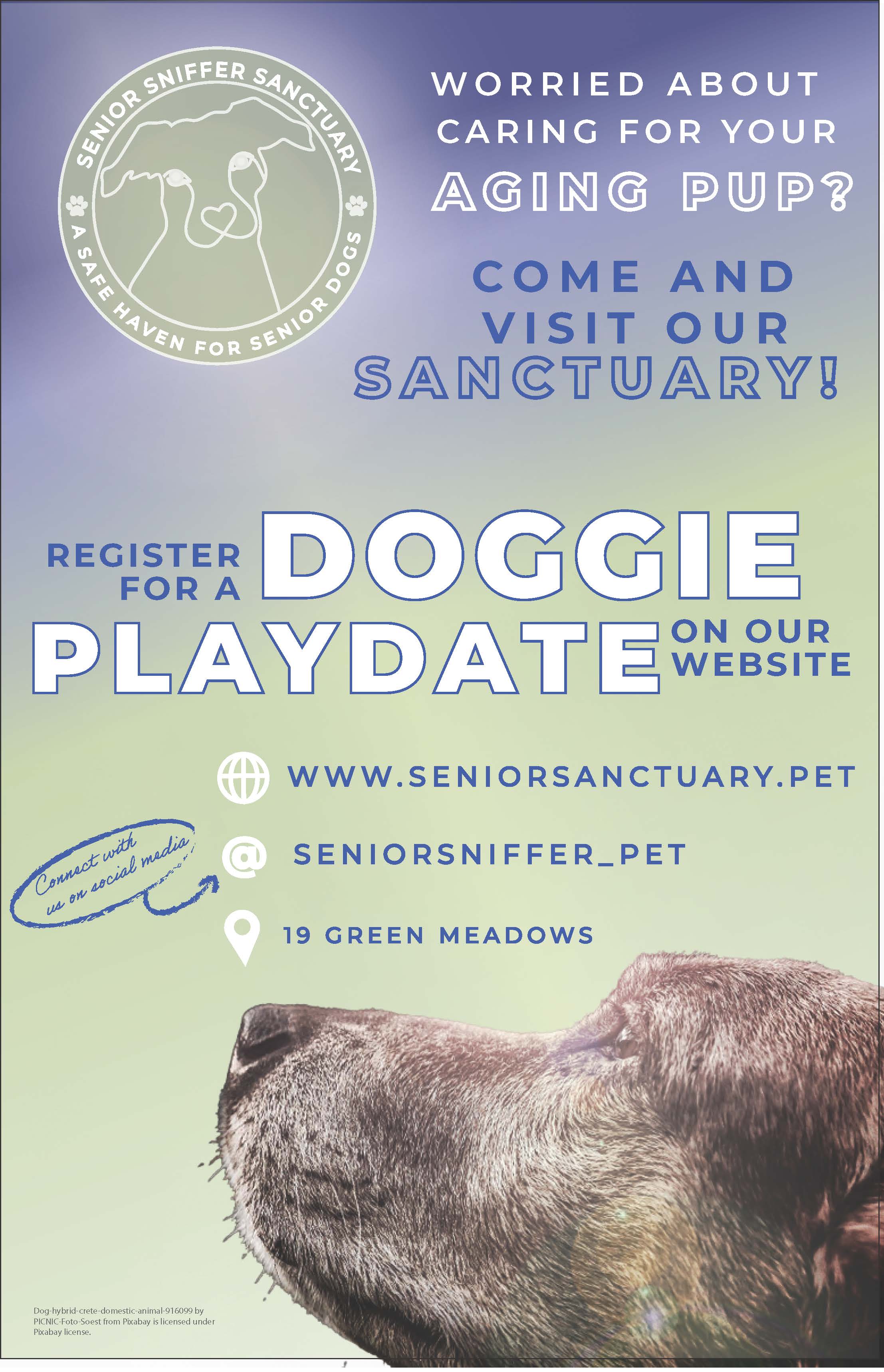
The objective was to create a visually striking promotional poster that relies on Swiss Design principles—prioritizing clarity, legibility, and a strict grid system. The challenge was to communicate all necessary event details while maintaining a "less is more" philosophy that stands out through bold geometry rather than visual clutter.
Design Strategy & Composition
1. Layout & Grid System
The composition is built on a modular grid, creating a sense of "asymmetrical balance."
Intentional Negative Space: By pushing the primary graphic and text to the edges, I utilized the central white space to create a "breathing room" that pulls the viewer's eye directly to the focal points.
Structural Alignment: Every element is locked into a vertical and horizontal axis, ensuring that the layout feels intentional and architecturally sound.
2. Typography & Hierarchy
Typography serves as both the delivery of information and a primary design element.
Font Choice: I utilized a clean, geometric sans-serif to reflect a modern and professional tone.
Scale Contrast: By significantly varying the point size between the headline and the body text, I created an immediate "hook" for the viewer while keeping the secondary details (date, location, and description) organized and accessible.
Vertical Orientation: Rotating the date/time elements adds a layer of visual interest and breaks the traditional "reading pattern," forcing the audience to engage more closely with the poster's details.
3. Color Theory
The palette was chosen to evoke a sense of serenity and happiness.
High-Contrast Palette: The use of a vibrant "pop" color (such as the primary yellow/orange) against a stark white background ensures that the poster is legible from a distance.
Sophisticated Accents: I used a deep charcoal for the primary text instead of a "pure" black to give the design a softer, more high-end feel while maintaining maximum contrast.
Key Technical Achievements
Vector Precision: All graphic elements were created using vector paths to ensure the poster can be scaled from a standard A4 flyer to a large-scale bus shelter ad without loss of detail.
Information Architecture: Developed a "scan-ready" layout where the most critical information (The "What") is seen first, followed by the "When" and "Where" in a logical, descending order.
The Result
The final design is a sophisticated, "clean" marketing asset that proves a design doesn't need to be loud to be heard. It showcases my ability to work within strict constraints and use the fundamentals of design—color, space, and type—to create a professional and effective piece of visual communication.